Canary Edge vs Nixtla TimeGPT: Which Is Better for Industrial Anomaly Detection?
By Roger Hahn | JD | MBA | MS Engineering | USPTO Reg. No. 46,376
Key Takeaways
- TimeGPT is a foundation model trained on 100B+ data points optimized for business metrics forecasting (daily, weekly, monthly cadences)
- Canary Edge uses a JEPA-based LeWM architecture optimized for sub-second industrial sensor data (vibration, temperature, pressure)
- TimeGPT detects anomalies through forecast-then-flag: forecast the next value, flag if actual deviates from forecast
- Canary Edge detects anomalies through latent-space prediction error: learn how embeddings evolve, flag when prediction energy spikes
- Choose TimeGPT for business metrics and demand forecasting; choose Canary Edge for industrial IoT and predictive maintenance
What Is Nixtla TimeGPT and How Does It Work?
Nixtla TimeGPT is a foundation model for time series forecasting trained on over 100 billion data points spanning retail, energy, finance, weather, and web traffic. It uses a transformer-based architecture to produce zero-shot forecasts — you send historical data and get predictions back without training a custom model.
TimeGPT's approach to anomaly detection is forecast-then-flag. The model forecasts the expected next values in a time series, constructs a confidence interval around those forecasts, and flags any actual values that fall outside the interval as anomalies. This works well for data with clear trends, seasonality, and daily or weekly patterns.
Nixtla also offers TimeGEN-1, an Azure-optimized variant available through Azure AI Services. TimeGEN-1 targets teams migrating from Azure's retiring services and provides the same forecasting capabilities with Azure-native authentication and billing. Both variants are accessed via REST API.
How Does Canary Edge's Approach Differ from TimeGPT?
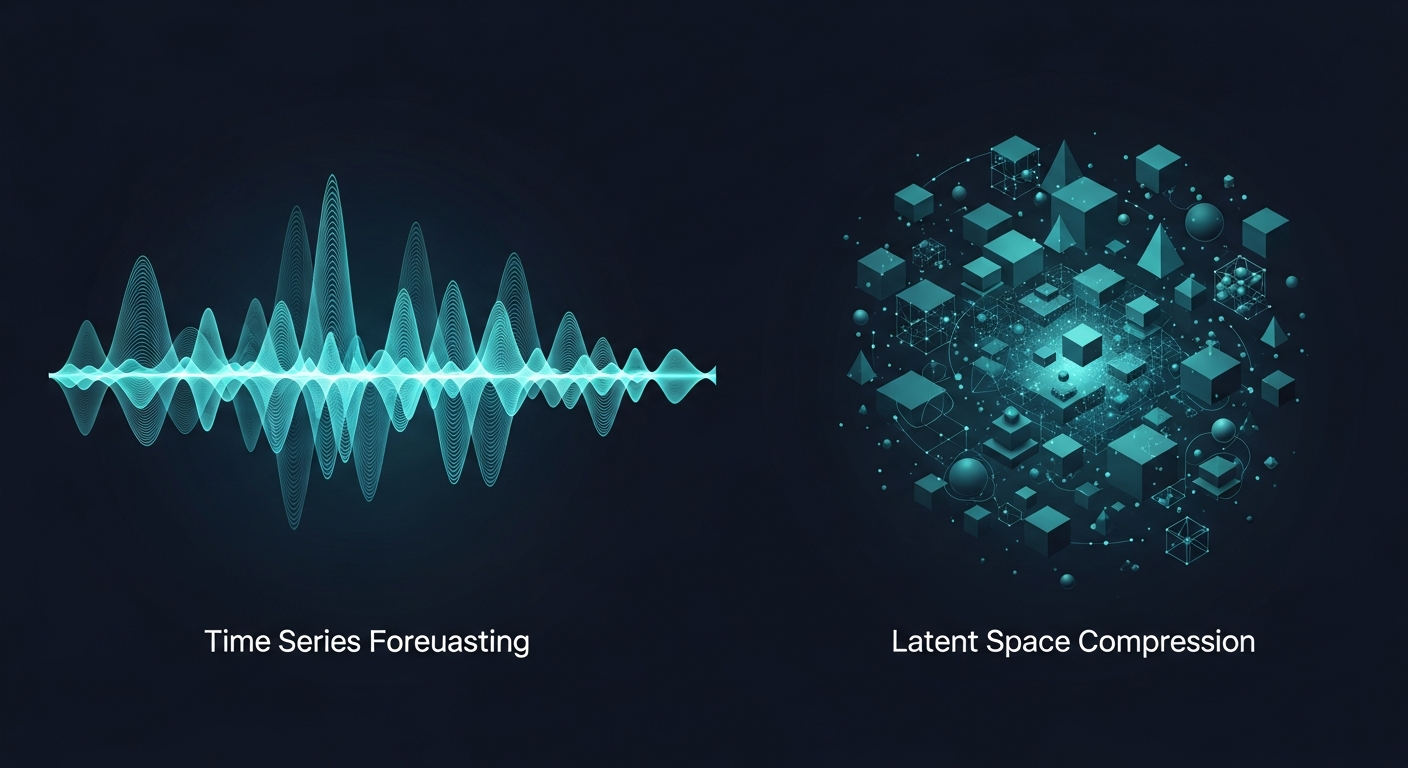
Canary Edge uses a fundamentally different detection mechanism. Instead of forecasting raw values, it learns how compressed representations of time series data evolve in a 192-dimensional latent space and measures prediction error in that space. This approach is called LeWM — Latent Embedding World Model.
The key architectural difference is what gets predicted. TimeGPT predicts the next raw data point value (e.g., "temperature will be 72.3 degrees"). Canary Edge predicts the next latent state embedding (a 192-dimensional vector that captures the temporal structure of a 2,048-sample window). When the actual latent state diverges from the predicted latent state, the prediction energy rises, signaling an anomaly.
This latent-space approach has a specific advantage for industrial data: it can detect subtle changes in signal dynamics (frequency shifts, amplitude modulation, phase changes) that do not necessarily produce out-of-range values. A bearing developing an outer race defect produces characteristic frequency peaks that change the embedding structure long before the overall vibration amplitude exceeds a threshold.
What Types of Data Is Each Platform Designed For?
This is the most important distinction between the two platforms. TimeGPT is designed for business metrics. Canary Edge is designed for industrial sensor data. The overlap is smaller than it appears.
| Characteristic | TimeGPT | Canary Edge |
|---|---|---|
| Primary data type | Business metrics, financial data, demand signals | Industrial sensor data (vibration, temperature, pressure, flow) |
| Typical sample rate | Daily, weekly, monthly | Sub-second to minutely (up to 20 kHz) |
| Series length | 50-10,000 points | 12-8,640 points per request |
| Seasonality | Strong daily/weekly/annual patterns | Quasi-stationary with sudden regime shifts |
| Anomaly pattern | Value exceeds forecast confidence interval | Latent dynamics shift (frequency, correlation, phase) |
| Multivariate | Independent per-series forecasts | Cross-channel correlation analysis (2-100 channels) |
| Pretrained on | 100B+ points: retail, energy, finance, weather | NASA IMS bearing run-to-failure dataset (vibration) |
| Fine-tuning | Optional fine-tuning on custom data | Per-machine fine-tuning on healthy baseline data |
TimeGPT excels at: Retail demand forecasting, energy load prediction, financial metric monitoring, web traffic anomaly detection — any domain where data arrives at daily or weekly intervals and anomalies manifest as values deviating from expected trends or seasonal patterns.
Canary Edge excels at: Predictive maintenance, equipment health monitoring, industrial process control — any domain where data arrives at high frequency and anomalies manifest as changes in signal dynamics, cross-sensor correlations, or developing mechanical faults.
How Do Latency and Architecture Compare?
Both platforms are cloud-hosted REST APIs, but their inference characteristics differ significantly due to the models they run.
| Metric | TimeGPT | Canary Edge |
|---|---|---|
| API style | Synchronous REST | Synchronous REST |
| Inference latency | 100-500ms (varies with horizon) | Sub-50ms |
| Batch support | Yes (multiple series per request) | Yes (up to 8,640 points per request) |
| Model size | Large foundation model (billions of params) | Compact pipeline (1.83M encoder + 890K cross-attention + 462K predictor) |
| GPU required | Server-side (Nixtla hosts) | Server-side (Canary hosts on GKE) |
| Azure integration | TimeGEN-1 on Azure AI Services | Azure Anomaly Detector compatible API format |
Canary Edge's lower latency comes from its compact model architecture. The full pipeline is approximately 3.2 million parameters — small enough to run inference in single-digit milliseconds on a GPU. TimeGPT's foundation model is orders of magnitude larger, which enables its zero-shot generalization across domains but increases inference time.
For real-time industrial monitoring where decisions must be made in milliseconds (e.g., triggering a machine shutdown), Canary Edge's sub-50ms latency provides a tighter control loop. For business metrics that update daily, TimeGPT's latency is negligible.
How Does Pricing Compare Between the Two?
Both platforms use consumption-based pricing, but the units differ. TimeGPT charges per API call or per forecast point. Canary Edge charges per data point processed.
| Tier | TimeGPT | Canary Edge |
|---|---|---|
| Free | Limited free credits for testing | 1,000,000 points/month, 5 machines |
| Paid | Per-call pricing (varies by model and horizon) | $99/month Pro tier (unlimited points, unlimited machines) |
| Enterprise | Custom pricing | Custom pricing |
For a team monitoring 10 industrial machines with 4 sensors each, sending 1,000 readings per sensor per day: - Daily data volume: 10 machines x 4 channels x 1,000 points = 40,000 points - Monthly data volume: 40,000 x 30 = 1,200,000 points - Canary Edge cost: $99/month (Pro tier, well within unlimited) - TimeGPT cost: Depends on the specific plan and call structure
The pricing models reflect the different use cases. TimeGPT is priced for data science teams running forecasts on moderate-volume business data. Canary Edge is priced for industrial teams processing high-volume sensor streams continuously.
When Should You Choose TimeGPT vs Canary Edge?
The choice depends entirely on your data type and detection requirements. These are complementary tools, not direct competitors.
Choose TimeGPT when: - Your data is business metrics (sales, demand, energy consumption, web traffic) - Data arrives at daily, weekly, or monthly intervals - You need forecast values, not just anomaly flags - Anomalies are values that deviate from expected trends or seasonal patterns - You want zero-shot detection without providing training data - You are migrating from Azure AI services and want to use TimeGEN-1 on Azure
Choose Canary Edge when: - Your data is industrial sensor readings (vibration, temperature, pressure, current) - Data arrives at sub-second to minutely intervals - You need regime classification (HEALTHY, ACTIVE, TRANSITION, SHOCK) - Anomalies are changes in signal dynamics, not just out-of-range values - You need cross-channel correlation analysis to detect correlated failures - You need per-channel contribution scores for root cause diagnosis - You are migrating from AWS Lookout for Equipment or Azure Anomaly Detector
Some organizations use both: TimeGPT for business-level KPI monitoring and Canary Edge for equipment-level predictive maintenance. The two systems monitor different layers of operational data.
Comments