How to Detect CNC Spindle Bearing Failure and Robot Joint Wear on Automotive Lines
By Roger Hahn | JD | MBA | MS Engineering | USPTO Reg. No. 46,376
Key Takeaways
- Automotive assembly line downtime costs $20,000-$50,000 per minute — Ford's published figure is $22,000/min, making unplanned stoppages the most expensive failure mode in manufacturing.
- CNC spindle replacements cost $10,000-$50,000 per unit and take 8-24 hours, but bearing degradation at 8,000-30,000 RPM follows a rapid failure curve — days, not weeks.
- Robot arm joint wear on Fanuc, ABB, and KUKA units is detectable 3-6 weeks early through servo torque ripple analysis, far before backlash affects part quality.
- EV battery housing machining is the fastest-growing CNC application, requiring tighter tolerances that make predictive spindle monitoring essential.
Why Is Unplanned Downtime on Automotive Lines So Catastrophic?
Unplanned downtime on an automotive assembly line costs between $20,000 and $50,000 per minute. Ford Motor Company has publicly disclosed a figure of $22,000 per minute for its truck assembly lines. General Motors, Toyota, and Stellantis report similar figures. A single 4-hour CNC spindle replacement translates to $5.3 million in lost production at Ford's rate.
These numbers are not hypothetical. Automotive lines run at fixed takt times — typically 50-60 seconds per vehicle. Every station is synchronized. When one CNC machining center or welding robot stops, the entire line stops within minutes as buffer stations empty.
The problem is compounded by just-in-time supply chains. There is no inventory buffer to absorb the production loss. Missed vehicles are missed revenue that cannot be recovered through overtime because the line is already running 18-22 hours per day across two or three shifts.
How Does AI Detect CNC Spindle Bearing Failure Before It Halts the Line?
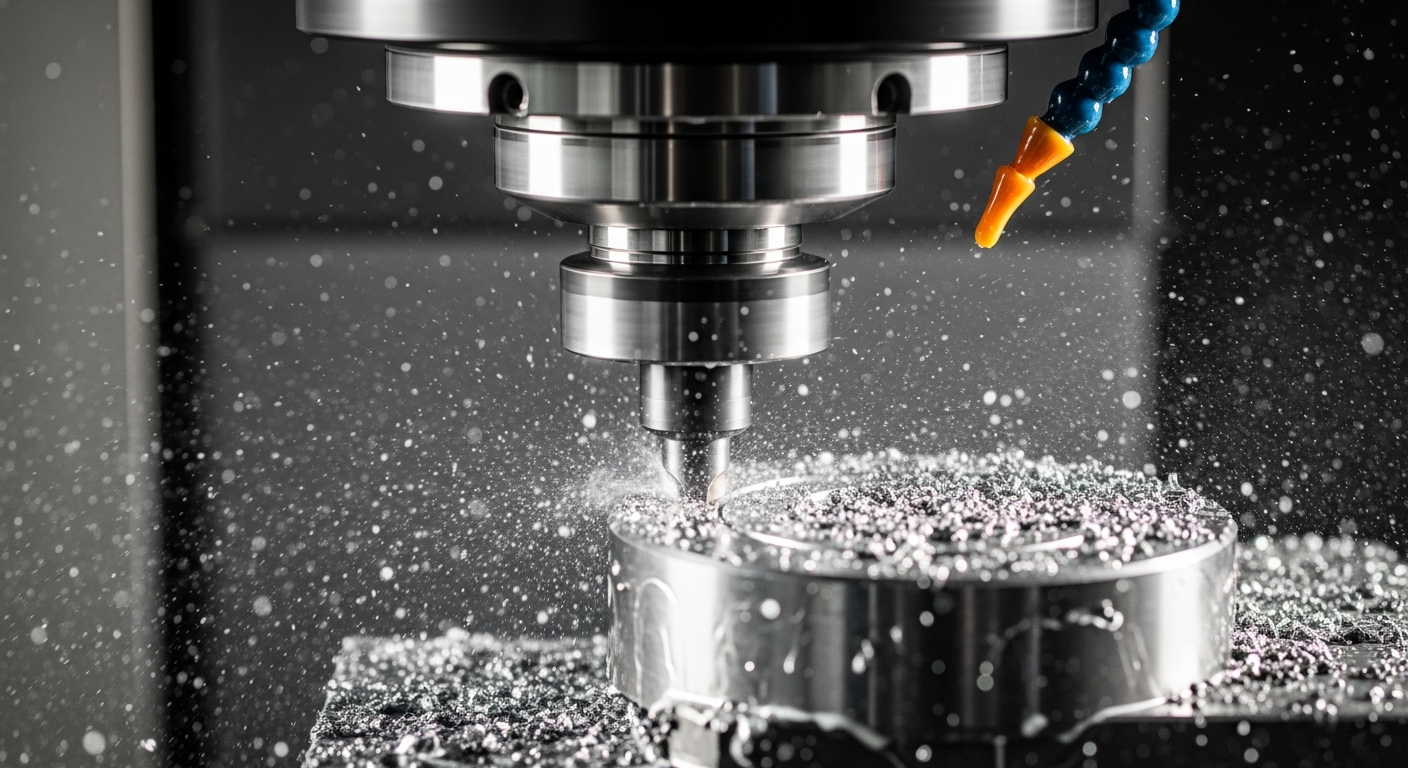
CNC spindle bearings operate at extreme speeds — 8,000 RPM on heavy-duty Mazak Integrex e-series turning centers, 12,000-15,000 RPM on DMG Mori NHX horizontal machining centers, and up to 30,000 RPM on Okuma MU-series 5-axis mills used for aluminum EV components. At these speeds, bearing degradation follows a compressed failure curve. The window from first detectable anomaly to catastrophic seizure is often 3-7 days, not the weeks or months you get with slower industrial equipment.
JEPA monitoring detects spindle bearing degradation by learning the normal vibration signature across the full operating envelope — different speeds, feed rates, tool loads, and material types. As inner or outer race defects develop, the model detects the characteristic bearing-defect frequency modulation well before it manifests as surface finish degradation on parts.
| Equipment | Spindle Speed Range | Typical Bearing Life | JEPA Detection Lead Time | Replacement Cost |
|---|---|---|---|---|
| Mazak Integrex e-670H | 4,000-10,000 RPM | 15,000-25,000 hrs | 5-10 days | $15,000-$25,000 |
| DMG Mori NHX 6300 | 8,000-15,000 RPM | 12,000-20,000 hrs | 3-7 days | $20,000-$35,000 |
| Okuma MU-8000V | 10,000-30,000 RPM | 8,000-15,000 hrs | 2-5 days | $25,000-$50,000 |
| Makino a81nx | 8,000-14,000 RPM | 15,000-22,000 hrs | 4-8 days | $18,000-$30,000 |
The critical insight is that faster spindles give you less warning. A shop running Okuma 5-axis mills at 25,000 RPM for aluminum EV battery housings may have only 48-72 hours between first detectable anomaly and spindle seizure. Continuous AI monitoring is not optional at these speeds — it is the only way to catch the failure in time.
How Can You Detect Robot Arm Joint Wear Before It Affects Part Quality?
Automotive lines deploy hundreds of industrial robots — Fanuc R-2000iC for heavy material handling, ABB IRB 6700 for welding, and KUKA KR Quantec for painting and sealing. Each robot has 6 joints, and each joint contains a precision reduction gear (Nabtesco RV or Harmonic Drive) that wears over 40,000-80,000 operating hours.
Joint wear manifests as backlash — increased play in the gear train that causes the tool center point (TCP) to deviate from its programmed path. In welding applications, a 0.3mm TCP deviation can cause missed welds. In machining applications, it causes dimensional drift. But operators typically do not notice until parts start failing quality inspection, by which time hundreds or thousands of suspect parts may have been produced.
JEPA monitoring detects joint wear through servo torque ripple analysis. The robot controller already reports motor current and position data at millisecond intervals via FANUC FOCAS, ABB RobotWare, or KUKA.Connect interfaces. As gear teeth wear, the torque required to move through specific arc segments changes — the model learns what normal torque profiles look like for each joint across all motion programs and detects deviation 3-6 weeks before backlash reaches reject-threshold levels.
This early detection is especially valuable for spot welding robots, where a single Fanuc R-2000iC may execute 4,000-5,000 welds per shift. A 3-week advance warning lets you schedule joint replacement during a planned weekend shutdown instead of losing a full shift of production.
Why Does EV Battery Housing Machining Demand Tighter Spindle Monitoring?
EV battery housing machining is the fastest-growing CNC application in automotive manufacturing, and it demands monitoring precision that ICE powertrain machining never required. A battery tray for a Ford F-150 Lightning or Tesla Model Y is a single aluminum casting up to 2.2 meters long with flatness tolerances of 0.1mm across the entire sealing surface.
The machining cycle runs at high spindle speeds (18,000-25,000 RPM) with light depth of cut on 5-axis machines. Any spindle vibration that would be imperceptible on a cast-iron engine block produces visible chatter marks on the soft aluminum sealing surface. A single bad tray is a $2,000-$5,000 scrap loss, and a spindle that goes undetected for a full shift can produce 20-40 scrap trays before quality catch sampling identifies the problem.
Traditional SPC (statistical process control) catches the problem after it happens. CMM (coordinate measuring machine) sampling catches it with a 30-60 minute delay. JEPA spindle monitoring catches the vibration shift in real time, before the first bad part is produced. For EV battery housing lines, that is the difference between a zero-scrap shift and a $100,000 scrap event.
How Does AI Monitoring Integrate with Existing Automotive Line Controls?
Automotive OEMs run highly standardized control architectures. The good news is that modern CNC machines and robots already produce the data needed for predictive monitoring — you just need to extract and analyze it.
CNC integration: Mazak uses MTConnect natively on MAZATROL SmoothAi controls. DMG Mori supports MQTT and OPC-UA via CELOS. Okuma provides the Okuma API on OSP-P500 controls. All three can stream spindle load, vibration (via built-in accelerometers on newer models), temperature, and positional accuracy data to an edge gateway without any machine modification.
Robot integration: Fanuc FOCAS2/ROBOGUIDE, ABB RobotWare 7, and KUKA.Connect each provide read-only access to servo data, cycle times, and error logs. An edge gateway aggregates data from 20-50 robots per zone and forwards to the Canary Edge API.
Line-level integration: Most automotive plants use an Andon system (typically from Delmia, Ignition, or Siemens MOM) for line status. Canary Edge alerts can feed directly into the Andon board as predictive warnings, giving team leaders advance notice to schedule a tool change or robot service during the next planned break.
Comments