How to Prevent Elevator Shutdowns in Commercial Buildings with AI Monitoring
By Roger Hahn | JD | MBA | MS Engineering | USPTO Reg. No. 46,376
Key Takeaways
- A single out-of-service elevator costs $500-$2,000 per day in tenant impact, service credits, and emergency repair premiums, with high-rise buildings averaging 20-40 unplanned outages per year across the fleet.
- Elevator machine bearings operate at 60-200 RPM (geared) or 80-300 RPM (gearless), speeds where conventional vibration analysis struggles — JEPA excels at slow-speed anomaly detection.
- Property management companies managing 50-500+ buildings (CBRE, JLL, Cushman & Wakefield) need fleet-wide visibility that OEM service contracts from Otis, Schindler, and ThyssenKrupp do not provide.
- Independent AI monitoring provides objective verification of OEM service quality, giving property managers data to hold service providers accountable.
Why Do Elevator Outages Cost So Much More Than the Repair Bill?
The direct repair cost of an elevator breakdown is typically $2,000-$15,000 depending on the component. But the total cost to a building owner or property manager is 5-10x higher when you account for tenant impact, regulatory consequences, and reputational damage.
A Class A office building in a major metro area charges $40-$80 per square foot annually. Tenants on floors 20+ have no alternative when an elevator is out of service. Extended outages trigger lease concession requests, and repeated outages drive tenant non-renewals. In a building generating $20-$50 million in annual rent, losing even one major tenant over elevator reliability costs $1-$5 million.
The math for a typical 30-story office building with 8 elevators:
| Cost Category | Per Outage | Annual (20-40 events) |
|---|---|---|
| Emergency repair premium (2x normal rate) | $3,000-$10,000 | $60,000-$400,000 |
| Tenant service credits / concessions | $500-$5,000 | $10,000-$200,000 |
| Security / lobby management overtime | $200-$500 | $4,000-$20,000 |
| Regulatory fines (code violations) | $0-$5,000 | $0-$50,000 |
| Tenant non-renewal risk (annualized) | Hard to quantify | $500,000-$2,000,000 |
Beyond direct costs, many jurisdictions (New York City, Chicago, San Francisco) now publish elevator performance data. Buildings with poor reliability records face scrutiny from prospective tenants, particularly enterprise tenants with accessibility requirements. NYC Local Law 175 requires annual reporting of elevator outages, making reliability a public record.
Why Is Slow-Speed Elevator Bearing Monitoring So Challenging?
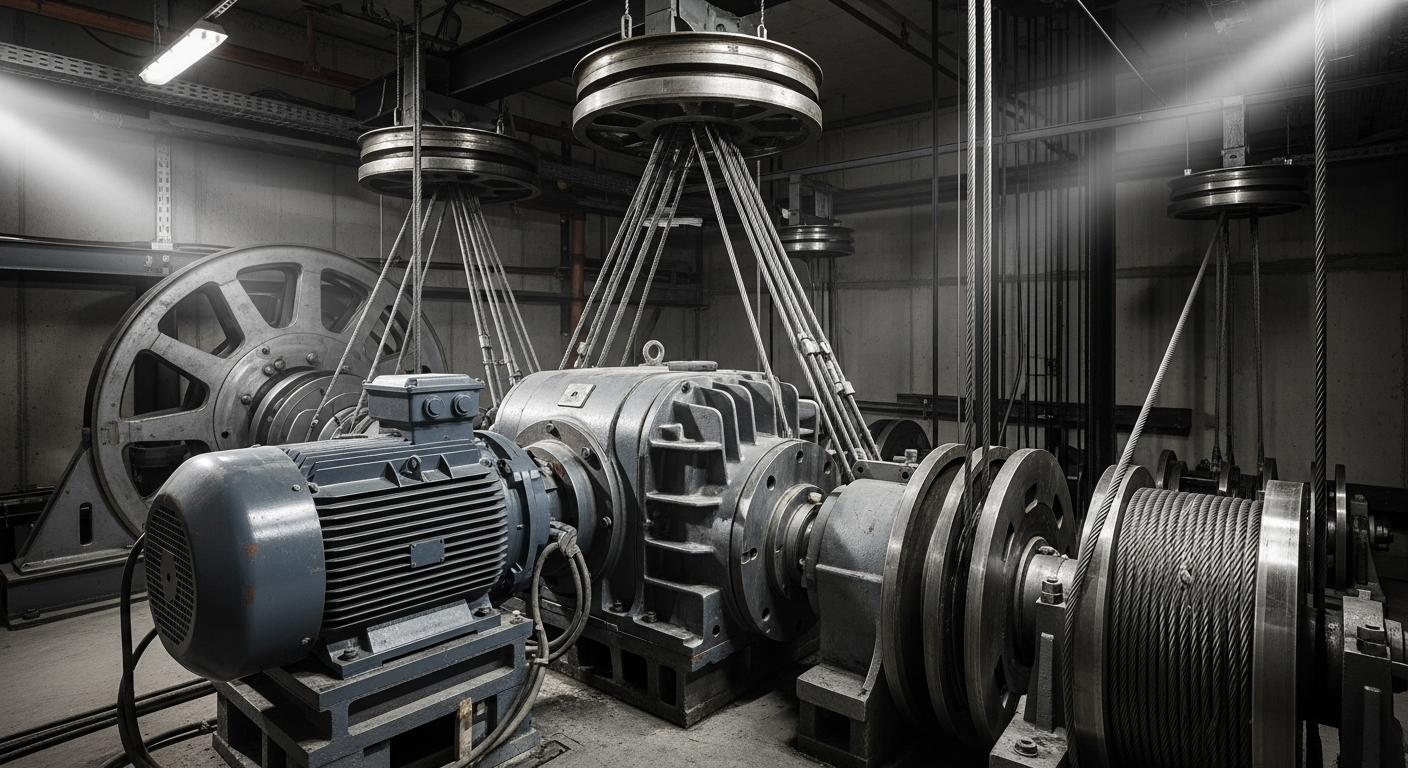
Elevator machines are among the most difficult rotating equipment to monitor because they operate at extremely low speeds. A geared traction machine (Otis Gen2 with ReGen drive, Schindler 3300, ThyssenKrupp Endura) typically runs the motor at 1,200-1,800 RPM, but the sheave rotates at just 60-200 RPM through a worm gear reduction. Gearless permanent magnet machines (Otis Gen3, Schindler 7000, KONE EcoDisc, ThyssenKrupp TWIN) operate even slower at 80-300 RPM.
At these speeds, bearing defect frequencies fall below 10 Hz — a range where building structural vibration, HVAC systems, and traffic create massive noise that drowns out the fault signal. Conventional accelerometer-based vibration analysis, which works well above 600 RPM, loses effectiveness dramatically below 300 RPM.
| Machine Type | Sheave Speed | Bearing Defect Frequency | Detection Difficulty |
|---|---|---|---|
| Geared traction (worm drive) | 60-200 RPM | 3-12 Hz | Very high |
| Gearless PM motor | 80-300 RPM | 5-18 Hz | High |
| Hydraulic (jack unit) | 0 RPM (linear) | N/A (seal wear) | Different approach needed |
| MRL (machine-room-less) | 80-250 RPM | 4-15 Hz | High (limited sensor access) |
This is precisely where JEPA's architecture provides a structural advantage. Traditional monitoring relies on frequency-domain analysis (FFT) to detect bearing defect frequencies. At low speeds, the energy at these frequencies is too small to extract from the noise floor. JEPA operates in the time domain, learning the full waveform pattern of healthy operation and detecting subtle shape changes that frequency analysis misses entirely.
How Does JEPA Detect Elevator Faults That Conventional Monitoring Misses?
JEPA learns the complete operational signature of each elevator machine — not just vibration, but motor current, drive temperature, brake release timing, leveling accuracy, and door operation metrics. This multi-parameter approach is essential because elevator faults rarely present as a single anomalous signal.
Bearing wear detection: The model tracks the relationship between motor current and sheave vibration across different load conditions (empty car, half load, full load) and travel directions (up, down). As a bearing degrades, the current-to-vibration ratio shifts — more energy is lost to friction. This ratio change is detectable 4-8 weeks before the bearing produces audible noise or measurable vibration at the defect frequency.
Drive fault detection: Modern elevator drives (Otis GECB, Schindler Miconic TX, ThyssenKrupp TAC) produce diagnostic data that includes DC bus voltage, IGBT temperature, and switching frequency. JEPA tracks thermal cycling patterns and capacitor ripple current trends that indicate electrolytic capacitor aging — the leading cause of drive failures. Capacitor degradation is detectable 3-6 months before failure.
Brake system monitoring: Elevator brakes are safety-critical components that must hold the car at floor level and stop the car in emergency conditions. JEPA monitors brake release current, engagement time, and the gap between brake pads and drum/disc. A brake that takes 15ms longer to release than its learned baseline may have a sticking solenoid or glazed friction surface.
Door operator monitoring: Door faults account for 60-70% of all elevator service calls. JEPA learns the normal current profile and timing of each door operator (typically a belt-driven DC or AC motor) and detects roller wear, belt stretch, and track contamination before doors begin sticking or reversing repeatedly.
Why Do Property Management Companies Need Fleet-Wide Elevator Visibility?
Property management firms like CBRE, JLL, Cushman & Wakefield, Colliers, and Newmark manage portfolios of 50-500+ buildings, each with 2-20 elevators. That is a fleet of 100-10,000 elevator units under management, serviced by multiple OEM providers under separate contracts with different SLA terms.
The current visibility model is broken. Property managers receive monthly service reports from each OEM — Otis, Schindler, ThyssenKrupp, KONE — in different formats, with different metrics, on different schedules. There is no unified view of fleet health, no way to compare performance across service providers, and no independent verification of whether the OEM actually performed the maintenance they invoiced.
This information asymmetry costs property managers millions annually. Common scenarios include:
- Phantom maintenance: OEM technician logs a PM visit but skips inspection items. Without independent monitoring data, the property manager has no way to verify.
- Deferred repairs: OEM identifies a worn component but delays replacement to reduce their service cost, hoping it lasts until the next contract cycle. The building suffers preventable outages.
- Unnecessary callbacks: OEM dispatches a technician for a "reported fault" that was actually a transient event. The callback fee is $500-$2,000 per visit.
Canary Edge provides property managers with an independent, OEM-agnostic view of elevator health across the entire portfolio. Every elevator in every building reports to a single dashboard. Performance metrics are normalized across equipment types and service providers, enabling direct comparison.
How Does Independent AI Monitoring Change the OEM Service Relationship?
The most valuable function of independent elevator monitoring is not prediction — it is verification. Property managers spend $5,000-$15,000 per elevator per year on full-service OEM maintenance contracts. For a 500-elevator portfolio, that is $2.5-$7.5 million annually. Independent monitoring data transforms this from a trust-based relationship to a data-driven one.
Specific use cases that change the service dynamic:
SLA enforcement: OEM contracts typically guarantee 96-98% uptime. Without independent monitoring, uptime is whatever the OEM reports. Canary Edge tracks actual out-of-service time to the minute, providing objective data for SLA credit claims.
Contract renewal negotiation: When the Otis or Schindler contract comes up for renewal, the property manager has 3-5 years of independent performance data. Elevators that required 30 service calls per year are verifiable, not anecdotal. This data supports competitive bidding and drives better contract terms.
Modernization planning: JEPA trend data shows which elevator machines are degrading fastest and estimates remaining useful life. This supports capital planning for modernization projects that cost $150,000-$500,000 per elevator. Property managers can prioritize the elevators that genuinely need replacement rather than accepting the OEM's recommendation (which is influenced by their revenue targets).
Regulatory compliance: Jurisdictions with elevator performance reporting requirements (NYC, Chicago, Boston) need accurate data. Independent monitoring provides the audit trail automatically, reducing compliance labor from hours per building per month to a single dashboard export.
For the major property management companies, the calculus is straightforward: independent monitoring costs $1,000-$3,000 per elevator per year and typically reduces total elevator operating cost by 15-25% through better SLA enforcement, fewer unnecessary callbacks, and optimized modernization timing.
Comments