How to Prevent Crusher and Conveyor Failures in Mining Operations
By Roger Hahn | JD | MBA | MS Engineering | USPTO Reg. No. 46,376
Key Takeaways
- Crusher downtime costs $500-$2,000 per hour in lost ore production, translating to $12,000-$144,000 per event for typical 6-72 hour repair windows.
- Extreme impact loading produces massive vibration spikes during normal operation, causing threshold-based monitors to generate 10-30 false alarms per week — operators ignore them all.
- JEPA learns what normal impact loading looks like for each crusher and feed condition, reducing false alarms by 90%+ while detecting genuine bearing and liner wear weeks earlier.
- Overland conveyor systems spanning 1-10+ km have thousands of idler bearings, making manual inspection impractical — AI monitoring prioritizes which idlers to replace during shutdowns.
Why Is Crusher Monitoring So Difficult Compared to Other Industrial Equipment?
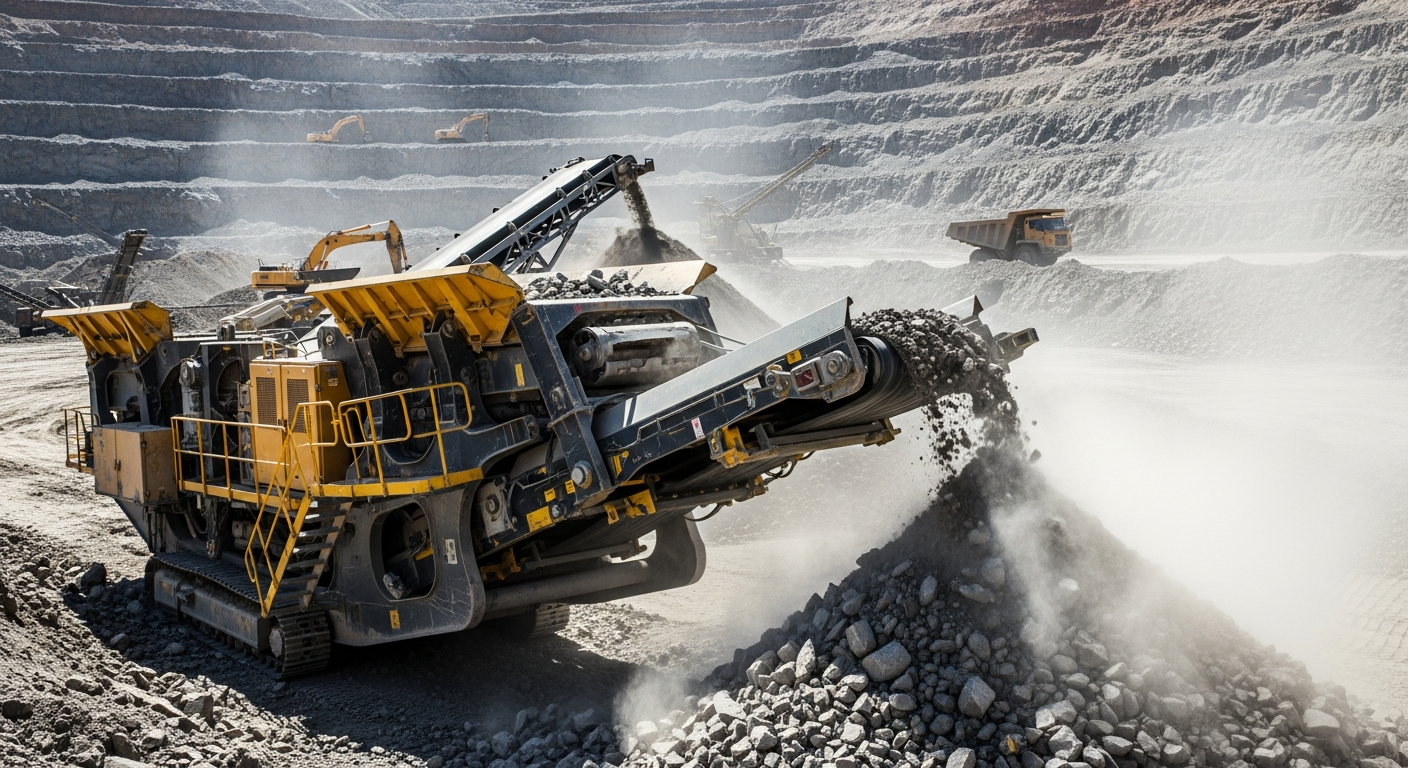
Crushers are the hardest equipment to monitor in any industry because their normal operating condition looks like an emergency on any other machine. A Metso Outotec C160 jaw crusher processing 1,200 tonnes per hour of hard rock ore produces vibration peaks of 20-50g on every jaw stroke. For comparison, a centrifugal pump throws a 0.5g alarm at most facilities.
This extreme dynamic range is why traditional threshold-based vibration monitoring fails spectacularly on crushers. Set the threshold low enough to catch bearing wear and you get 10-30 false alarms per week from normal tramp iron events, bridging episodes, and feed size variations. Set the threshold high enough to avoid false alarms and you miss every real fault until the crusher is already damaged.
The result is predictable: operators ignore vibration alarms on crushers. In a 2023 survey of 45 Australian mine sites, 78% of maintenance supervisors reported that crusher vibration alarms were routinely acknowledged and dismissed without investigation. The alarm system is technically present but operationally useless.
How Does AI Monitoring Distinguish Real Faults from Normal Impact Loading?
JEPA solves the crusher monitoring problem by learning what normal impact loading looks like for each specific crusher, feed material, and operating condition. Instead of asking "is this vibration level above a threshold?" it asks "does this vibration pattern match what I expect given the current feed rate, CSS setting, and operating hours since the last liner change?"
This contextual approach produces dramatically different results:
| Metric | Threshold Monitor | JEPA Monitor |
|---|---|---|
| False alarms per week | 10-30 | 0-2 |
| Missed faults per year | 3-8 | 0-1 |
| Operator trust level | Very low (ignored) | High (acted upon) |
| Bearing failure lead time | 0-3 days | 14-28 days |
| Liner wear prediction accuracy | Not possible | +/- 5-10% of remaining life |
The model also distinguishes between different fault types. Eccentric bearing wear on a Sandvik CH870 cone crusher produces a 1x rotational frequency component that grows linearly. A cracked mantle produces a 2x harmonic. A loose concave ring produces an intermittent broadband burst. Each has a distinct signature that JEPA learns from the first occurrence and tracks going forward.
For jaw crushers like the Metso Outotec C130 or C160, the model tracks toggle plate stress, pitman bearing temperature, and flywheel vibration independently. This lets it differentiate between a worn toggle seat (maintenance can wait), a degraded pitman bearing (schedule replacement within 2 weeks), and a cracked frame (stop immediately).
How Do You Monitor Thousands of Conveyor Idlers Across Kilometers of Belt?
A single overland conveyor system at a large mine can span 1-10+ kilometers and contain 5,000-20,000 individual idler rollers. Each idler has two bearings, meaning a 5 km conveyor has 10,000-40,000 bearing failure points. Manual inspection of every idler takes a crew of 4 technicians a full week — and by the time they finish, the first idlers they checked may have degraded further.
Failed idler bearings seize, causing the rubber lagging to burn through and the steel shell to cut into the belt. A single seized idler can destroy a 10-meter section of conveyor belt in under an hour. Belt replacement costs $500-$1,500 per linear meter for heavy-duty mining belt (Continental, Fenner Dunlop, or Bridgestone ST-series steel cord belt), meaning a single missed idler can cause $5,000-$15,000 in belt damage.
Canary Edge monitors conveyor idlers through acoustic and vibration data collected by fixed sensors at 200-500 meter intervals along the conveyor. The JEPA model learns the acoustic signature of healthy idlers passing under each sensor location and flags idlers producing abnormal noise or vibration patterns.
This approach turns an impossible manual task into an automated priority list: "Replace idlers at positions 347, 892, and 1,203 during the next planned shutdown." Maintenance crews spend their time replacing the specific idlers that need attention instead of walking the full belt hoping to hear a squealing bearing over 90+ dB ambient mine noise.
How Does AI Monitoring Apply to Ball Mills and SAG Mills?
Ball mills and SAG (semi-autogenous grinding) mills are the highest-value single assets at most mining operations, with replacement costs of $5-$20 million and lead times of 12-18 months for major components. A Metso Outotec Premier SAG mill or an FLSmidth XTRA grinding mill runs at 10-15 RPM, processing 2,000-5,000 tonnes per hour.
At these slow speeds, conventional vibration analysis is nearly useless. The rotational frequency is 0.17-0.25 Hz — well below the detection floor of most commercial accelerometers. Bearing defect frequencies are proportionally low, buried in noise.
JEPA monitoring overcomes this by combining multiple data streams: bearing temperature trends, lube oil particle counts, motor current signature, shell vibration (using low-frequency MEMS accelerometers like the PCB 393B04), and mill sound (using external microphones that detect changes in charge dynamics).
| SAG/Ball Mill Component | Replacement Cost | Lead Time for Parts | JEPA Detection Lead Time |
|---|---|---|---|
| Trunnion bearing (Metso Premier) | $800,000-$1,500,000 | 6-12 months | 30-90 days |
| Ring gear (FLSmidth XTRA) | $1,200,000-$2,000,000 | 12-18 months | 60-120 days |
| Pinion bearing | $150,000-$400,000 | 4-8 weeks | 21-42 days |
| Mill liner set | $500,000-$1,000,000 | 4-6 weeks | Continuous wear tracking |
The long detection lead times for mill components matter enormously because the parts themselves have long lead times. Detecting a trunnion bearing defect 90 days out gives procurement time to source the replacement. Detecting it 3 days out means the mill sits idle for months waiting for parts.
Why Do False Alarms Cause More Damage Than No Monitoring At All?
The most dangerous monitoring system in mining is one that produces frequent false alarms. False alarms do not just waste time — they actively train operators to ignore all alarms, including real ones.
This is not a theoretical concern. The 2019 failure of a primary gyratory crusher at a major copper mine in Chile went undetected for 72 hours despite the vibration monitoring system alarming repeatedly in the weeks before failure. Maintenance records showed that the system had generated 23 false alarms in the prior month. The crew had developed a routine: acknowledge alarm, reset, continue production. When the real alarm came, they followed the same routine.
The economic damage was $12 million in crusher repair costs plus $30+ million in lost production during the 6-week rebuild. The monitoring system had technically detected the fault. The organizational response to chronic false alarms neutralized it.
JEPA monitoring addresses this by maintaining a false alarm rate below 2% on crushing equipment — low enough that every alert warrants investigation. When the system flags a bearing defect on a Sandvik CG820 gyratory crusher, maintenance knows from experience that 98%+ of alerts correspond to real conditions requiring action.
Comments