How to Detect Pump and Blower Failure at Remote Water Treatment Stations
By Roger Hahn | JD | MBA | MS Engineering | USPTO Reg. No. 46,376
Key Takeaways
- A single pump failure at an unmanned station costs $20K-$100K in emergency repair, plus potential EPA consent decree fines of $25K-$50K per day of non-compliance.
- Positive displacement blower lobe wear produces a detectable vibration signature 2-4 weeks before failure, but only if monitoring runs continuously at remote sites.
- SCADA systems from Allen-Bradley, Schneider Electric, and Siemens can forward data to Canary Edge via OPC-UA or Modbus-to-API gateways with zero PLC reprogramming.
- Aeration blower failure is the single most critical equipment event in activated sludge treatment, causing permit violations within 4-6 hours.
Why Are Remote Water Treatment Stations So Vulnerable to Equipment Failure?
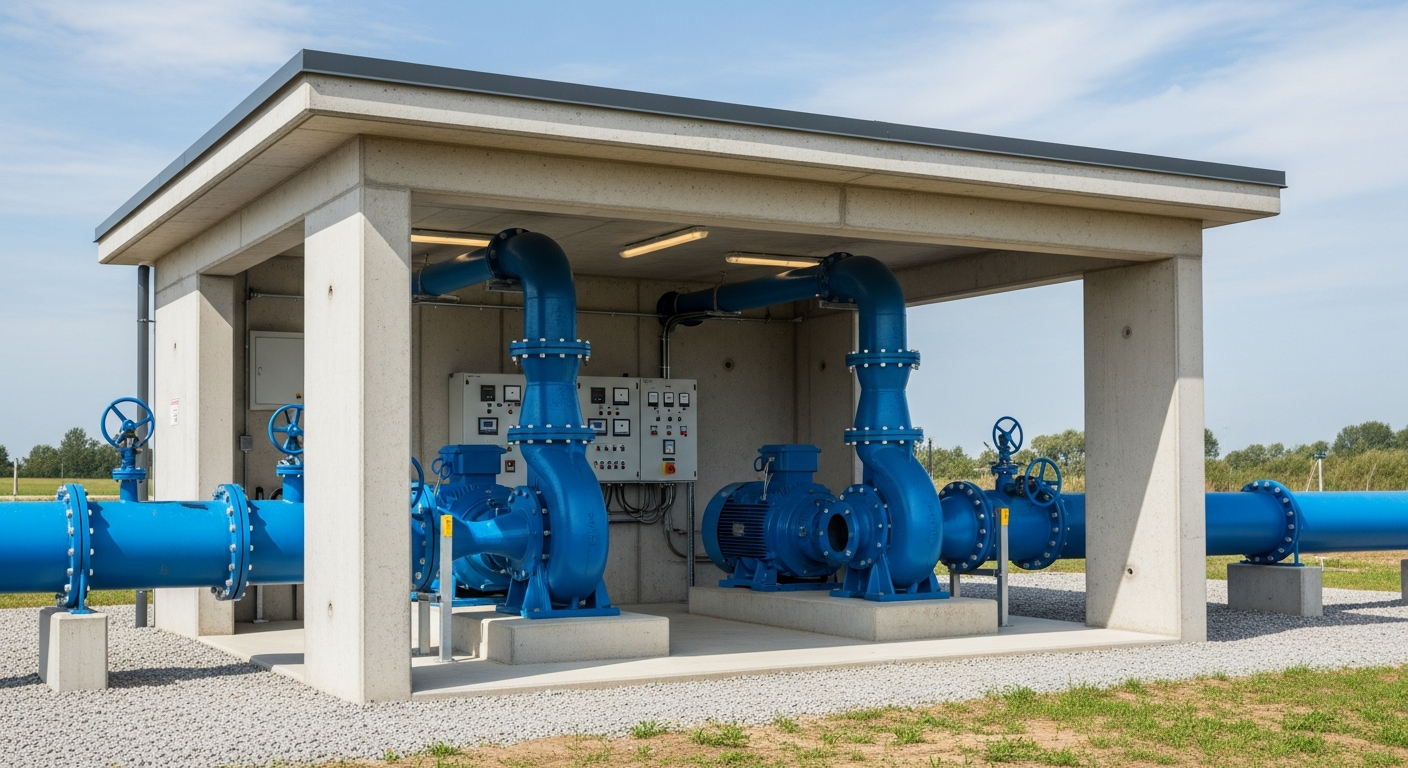
Remote water and wastewater stations are the most failure-prone assets in municipal infrastructure because they operate unmanned for days or weeks at a time. A lift station pump or aeration blower can fail silently, with no operator present to notice the change in sound, temperature, or flow rate that would trigger an immediate response at a staffed plant.
The cost of a single undetected pump failure ranges from $20,000 to $100,000 depending on the equipment size and whether the failure causes a sanitary sewer overflow (SSO). EPA consent decrees for SSO events carry penalties of $25,000-$50,000 per day of violation. In 2024, the City of Jackson, Mississippi faced over $600 million in required system upgrades after repeated SSO violations.
Most remote stations rely on simple run/fail SCADA alarms. The pump either reports "running" or "faulted." There is no middle ground — no early warning that a bearing is degrading, a seal is leaking, or a blower lobe is wearing. By the time the alarm trips, the equipment is already destroyed.
How Can AI Detect Blower Lobe Wear Before Aeration Systems Fail?
Aeration blower failure is the single most critical equipment event in activated sludge wastewater treatment. When a positive displacement blower (Roots, Howden, or Gardner Denver) loses a lobe seal, the biological treatment process begins to collapse within 4-6 hours as dissolved oxygen levels drop below the 2.0 mg/L threshold needed to sustain aerobic bacteria.
JEPA-based monitoring detects blower lobe wear by learning the normal vibration and current draw signature of each blower under varying load conditions. As lobes wear, the vibration pattern shifts — the inter-lobe gap increases, producing a characteristic low-frequency pulse that grows in amplitude over 2-4 weeks before catastrophic failure.
| Detection Method | Lead Time | False Alarm Rate | Remote Capable |
|---|---|---|---|
| Operator rounds (manual) | 0 days (staffed only) | N/A | No |
| SCADA high-current alarm | 0-1 days | 15-25% | Yes |
| Threshold vibration monitor | 3-7 days | 10-20% | Yes |
| JEPA predictive model | 14-28 days | Under 2% | Yes |
Traditional threshold-based vibration monitors struggle at remote sites because ambient conditions vary with temperature, flow rate, and number of units online. A fixed threshold that works in January will produce false alarms in August when ambient temperatures raise baseline vibration by 10-15%. JEPA adapts to these seasonal and operational shifts automatically.
How Do You Integrate SCADA Systems with AI Monitoring Without PLC Changes?
The biggest barrier to predictive monitoring at water utilities is the perception that integration requires reprogramming PLCs or modifying existing SCADA configurations. This is not the case. Canary Edge integrates at the data layer, not the control layer.
Three integration paths exist for the most common SCADA platforms:
Allen-Bradley (Rockwell ControlLogix/CompactLogix): Use the FactoryTalk Linx OPC-UA server to expose PLC tags. An edge gateway (Moxa, Advantech, or Red Lion) subscribes to vibration, current, pressure, and flow tags and forwards them to the Canary Edge API over cellular or satellite backhaul. No ladder logic changes required.
Schneider Electric (Modicon M340/M580): The EcoStruxure OPC-UA module provides native tag export. Alternatively, a Modbus TCP gateway polls registers at 1-second intervals and converts to API calls. Schneider's Geo SCADA platform can also push data directly via its historian export function.
Siemens (S7-1500/ET 200SP): The S7 OPC-UA server is built into TIA Portal v16+. For older S7-300/400 installations, a KEPServerEX gateway bridges Profinet or MPI to OPC-UA, then to the Canary Edge REST API.
All three paths use read-only data access. The AI monitoring system never writes to the PLC, never changes setpoints, and never modifies control logic. It is a passive listener that produces alerts.
How Does AI Monitoring Work for Submersible Pumps You Cannot Physically Inspect?
Submersible pumps present a unique monitoring challenge: you cannot see them, touch them, or attach external sensors without pulling them from the wet well — a process that costs $5,000-$15,000 per pull and takes a full crew day.
JEPA monitoring solves this by analyzing the electrical signature of the pump motor from above-ground motor control center (MCC) data. Current draw, power factor, voltage imbalance, and start/stop transients contain rich diagnostic information about what is happening below the surface.
A healthy Flygt NP 3127 submersible pump draws 28-32 amps at full flow and exhibits a consistent startup inrush of 180-210 amps for 0.3-0.5 seconds. As the impeller erodes from grit and rag accumulation, the steady-state current drops while startup inrush extends — the motor is working harder to overcome increased friction but moving less fluid.
Canary Edge learns this signature per pump and flags degradation weeks before the pump fails or trips on thermal overload. Utilities using this approach have reported 30-40% reductions in emergency pull-and-replace events, extending the average submersible pump service life from 3-5 years to 5-8 years.
Why Is Aeration System Monitoring the Highest-Priority Investment for Treatment Plants?
Aeration accounts for 50-65% of total energy consumption at a typical activated sludge wastewater treatment plant. A 10 MGD plant spends $400,000-$800,000 per year on aeration energy alone. Even a 5% degradation in blower efficiency translates to $20,000-$40,000 in wasted electricity annually — before counting the risk of permit violations from inadequate dissolved oxygen.
The math makes aeration monitoring the single highest ROI predictive maintenance investment at any treatment plant:
| Component | Replacement Cost | Failure Consequence | Detection Lead Time (JEPA) |
|---|---|---|---|
| PD blower (Roots 800 series) | $35,000-$65,000 | Loss of DO, permit violation in 4-6 hrs | 14-28 days |
| Turbo blower (APG-Neuros) | $80,000-$150,000 | Same as above, longer lead time on parts | 21-42 days |
| Fine bubble diffuser grid | $50,000-$200,000 (full replacement) | Reduced oxygen transfer, energy waste | 30-60 days (fouling trend) |
| Submersible mixer | $15,000-$30,000 | Dead zones, short-circuiting | 7-14 days |
Turbo blowers from manufacturers like APG-Neuros, Sulzer, and Atlas Copco are increasingly common in new installations. Their high-speed bearing systems (40,000-60,000 RPM) demand continuous monitoring — a bearing failure at those speeds destroys the entire rotating assembly in seconds.
Comments